Your next decision
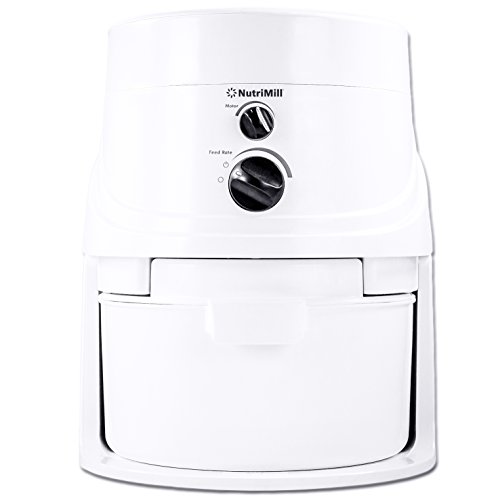
Compare the documented fit, complete setup and limitations for NutriMill Classic, NutriMill Harvest, WonderMill Electric.
See the model shortlist ↓Decide what must come out of the mill
Write down your three most common jobs: for example, flour for a weekly bread bake, a small amount of rice flour, or cracked grain for a cooked cereal. Flour and cracked grain are different outputs. A coarse setting on an impact machine is not proof that it will produce the cracked texture you have in mind.
Use the grain compatibility checker to narrow the documented options. Ingredients absent from a model’s approved list remain unknown; they do not become suitable because a different mill accepts them.
Choose a collection workflow
An enclosed canister can make it easier to prepare a defined batch, but it has a maximum capacity and requires its lid, separator and filter to be correctly assembled. A chute-and-bowl mill lets you choose a receiving bowl; you still need enough clearance beneath the outlet and space to remove the full bowl.
Count that complete operating area when comparing machines. A motor housing measurement alone omits the canister or bowl. If you plan to store the mill between uses, also consider lifting it, locating every removable part and keeping grain storage nearby.
The compatibility checker separates documented permissions from unknown combinations.
Check your grain →Read electrical and loading details for the exact unit
A product family may be sold in different electrical versions. Verify the nameplate voltage, regional model and supplied manual; a plug adapter does not establish electrical compatibility. We keep international Mockmill references separate from unverified US offers.
Loading rules also differ. The WonderMill US manual requires power before grain, while the current Classic manufacturer page describes loading grain first. Follow the procedure for your own model. Do not generalize one machine’s restart instructions across all impact mills.
Compare limits before comparing extras
Check approved ingredients, collection capacity, required cooling periods, cleaning access and available replacement parts. Motor wattage alone does not measure flour fineness, noise, ease of use or long-term reliability. We have not performed hands-on tests of these products.
The mill finder explains why an option makes the shortlist. If your intended ingredient or electrical version is unconfirmed, obtain that answer before choosing the offer. For a power-free alternative, read the manual-mill buying guide.
Questions answered
What is an electric grain mill?
It is a motor-driven appliance that reduces suitable grains to flour or meal. Home models use different milling mechanisms and have model-specific ingredient restrictions.
Which grain mill grinds the finest flour?
We cannot identify a universal winner without comparable testing with the same grain, moisture, settings and measurement method. Manufacturer descriptions of “fine” are not standardized performance tests.