Your next decision
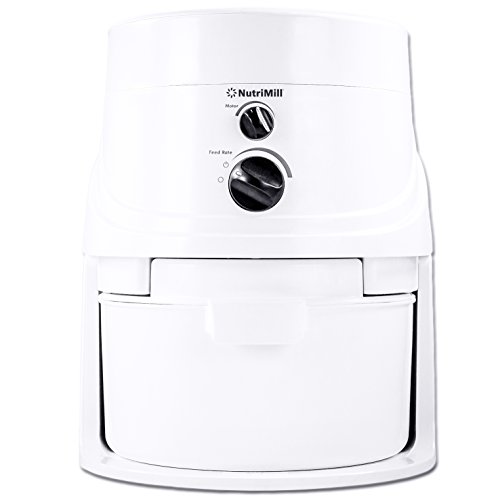
Compare the documented fit, complete setup and limitations for NutriMill Harvest, NutriMill Classic, WonderMill Electric.
See the model shortlist ↓| Decision | Stone examples | Impact examples |
|---|---|---|
| Documented grain path | Hopper → adjusted stones → outlet chute → your bowl | Hopper → impact heads → specified flour canister or bowl |
| Collection | Harvest/Mockmill: your own bowl | Classic/WonderMill: specified flour canister |
| Coarser output | Check documented cracked-grain range | Coarse flour is not necessarily cracked grain |
| Cleaning | Keep Harvest/Mockmill stones dry | Keep motor/chamber dry; collection parts differ |
| Oily ingredients | Not a general permission | Not a general permission |
Follow the grain through the documented system
Start with a suitable dry grain in the hopper and the collection system assembled for the exact mill. In a stone mill, the model’s adjustment changes the space or relationship between the grinding surfaces, and flour leaves through a chute into a receiving bowl. In an impact mill, high-speed milling heads reduce the grain and the specified bowl or canister captures the flour. Those descriptions explain the documented system—not the startup sequence for every machine.
Loading order can differ even within one mechanism category. The WonderMill manual requires the motor to be running before grain is added, while NutriMill Classic’s current page describes a different normal loading sequence. Use the first-batch guide and the instructions supplied with the exact unit before operating it.
Choose this when the output matters
A stone model with a documented cracked-grain range is worth comparing when you want both flour and coarser cereal ingredients. An impact model is worth comparing when your central task is flour and an enclosed collection system suits your baking. Neither category guarantees a particular recipe result.
Look at the exact grain and desired texture together. Milling corn for fine flour, a coarse meal and a cracked cereal are three related but different jobs. Use the corn-milling guide before assuming a coarse dial label answers all three.
The compatibility checker separates documented permissions from unknown combinations.
Check your grain →The bowl can be the deciding difference
If you want to collect directly into an existing bowl, confirm that it fits beneath the specific stone mill’s outlet. If you prefer an enclosed canister, compare its assembly, capacity and cleaning process. Both approaches need a planned space for loading and removing flour.
A full canister may be awkward in a confined work area, while an open bowl needs appropriate positioning. We have not tested dust containment, lifting comfort or noise, so those qualities are not ranked as if we had.
Avoid a universal ingredient rule
A stone mechanism does not automatically make nuts or coffee suitable. Mockmill’s 100/200 manual excludes several oily ingredients, while the separate Wonder Junior manual family describes specific alternate parts for some of those tasks. The oil, nut and coffee guide keeps those cases distinct.
Even ordinary grain permissions differ. An approved list for one model is not proof for its competitors. Check hulls, moisture, preparation and any model-specific feed requirements.
What specifications cannot tell us
Motor watts, promotional temperature figures and a broad “fine flour” claim are not a controlled performance comparison. Grain, feed rate, grind setting and measurement method would all need to be held consistent.
Use our mill finder for a documented shortlist, then resolve the exact model’s missing details. Choose the system that fits the work you intend to do without treating a mechanism label as a quality score.
Questions answered
How does a grain mill work?
A home grain mill feeds a permitted dry grain into its milling mechanism, reduces it to flour or meal, and moves that output into the model’s bowl or canister. Stone and impact mills use different mechanisms and collection paths, so follow the exact model’s loading, adjustment and stopping instructions.
What is a grain mill used for?
A home grain mill is used to reduce suitable dry grains into flour, meal or another documented texture. The exact output and ingredient range depend on the mill; a flour setting does not automatically establish cracked grain, oily-food or wet-food permission.
Is a stone grain mill better than an impact mill?
Neither is universally better. Compare the output, permitted ingredients, collection system and care instructions of the exact models.
Do stone mills grind oily seeds?
Not as a general rule. Follow the exact manufacturer list; stone mills such as Mockmill 100/200 exclude several oily ingredients.