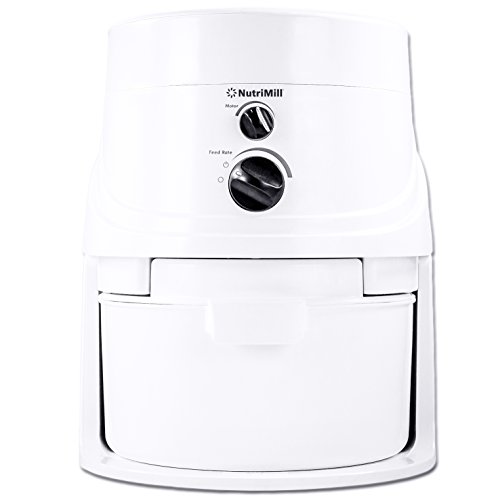
Your next decision
Compare the documented fit, complete setup and limitations for KitchenAid KGM, NutriMill Classic, NutriMill Harvest.
See the model shortlist ↓| Model family | Rice evidence | Oat evidence |
|---|---|---|
| NutriMill Classic | Current resources list white and brown rice; current help also lists wild rice. Parboiled is not established. | Oat groats are listed. Rolled and steel-cut oatmeal are explicitly excluded. |
| NutriMill Impact | Current resources list white and brown rice. Parboiled is not established. | Oat groats are listed. Rolled and steel-cut forms are not established by the cited page. |
| NutriMill Harvest | Current resources and guide list white, brown and wild rice. Parboiled is not established. | Oat groats are listed. Rolled and steel-cut forms are not established by the cited sources. |
| KitchenAid KGM | Current Product Help lists white and brown rice. Parboiled is not specifically established. | Hulled oats and rolled oats are explicitly listed. |
| Mockmill 100 / 200 | The shared manual lists natural long-grain rice and explicitly excludes parboiled rice. | The manual lists oats with separate 100/200 settings, but does not identify rolled oats. |
| WonderMill Electric | The US manual supports dry rice; this evidence does not extend that permission to parboiled or cooked rice. | The exact oat form is not established in the cited evidence; confirm before milling. |
Use a two-part identity before milling rice
Record both the rice type and preparation shown on the package. “Long-grain” does not answer whether the product is parboiled, and a broad permission for rice does not automatically cover cooked, instant or otherwise prepared rice. Keep the grain dry and within the exact machine’s instructions.
For example, the Mockmill 100/200 manual lists natural long-grain rice and says no parboiled rice. The NutriMill and KitchenAid sources above list particular white, brown or wild forms without granting a general parboiled-rice permission. In those cases, parboiled remains unconfirmed rather than silently approved.
Separate oat groats from rolled and steel-cut oats
Oat groats are the whole hulled grain used by several flour mills. Rolled and steel-cut oats are different prepared forms. NutriMill Classic explicitly excludes rolled and steel-cut oatmeal, while KitchenAid Product Help explicitly allows hulled oats or rolled oats for KGM.
Impact and Harvest resources list oat groats but do not establish rolled or steel-cut forms on the cited pages. Mockmill lists “oats” and model-specific settings without naming rolled oats. Those gaps are reasons to confirm the exact form, not reasons to borrow KitchenAid’s permission.
The compatibility checker separates documented permissions from unknown combinations.
Check your grain →Run the label through the exact-model check
Start with the package wording, then use the compatibility checker for the exact model and form. A supported result points to the source used here. An unknown result means the form was not verified; it is not a weaker version of approval.
A practical example: a bag labeled oat groats has direct support for Classic, Impact and Harvest, and KitchenAid permits hulled oats. A canister of rolled oats has explicit support for KGM, an explicit Classic exclusion and no verified permission here for Impact, Harvest, Mockmill or WonderMill Electric. Resolve that difference before loading the hopper.
Plan flour, not flakes or a universal substitute
A flour mill reduces an approved dry ingredient to flour or meal. It does not make rolled oats; that is a flaking job. If you want intact flattened oats, investigate a purpose-built flaker and its own instructions. No flaker offer has been verified for this catalog.
For flour, begin with a small documented batch within the machine’s limits. Record the exact rice or oat form, model, setting and collected output in the milling notebook. Do not assume one mill’s setting, fineness or recipe substitution transfers to another.
Keep dietary suitability separate from machine permission
Mechanical permission does not certify the flour as gluten-free. Ingredient sourcing, labeling, prior mill use and cross-contact are separate questions, especially for oats. Read the gluten-free milling guide before treating a supported machine combination as a dietary guarantee.
Use a recipe written for the flour you actually made and follow appropriate cooking directions. This guide does not promise a universal substitution, texture or yield, and a model-specific cleaning instruction must not be transferred to another mill.
Questions answered
Can I grind rolled oats in a grain mill?
Only when the exact model permits that form. Current KitchenAid KGM guidance allows rolled oats; NutriMill Classic explicitly excludes them. Rolled oats remain unconfirmed here for Impact, Harvest, Mockmill 100/200 and WonderMill Electric.
Can Mockmill grind parboiled rice?
No. The referenced Mockmill 100/200 manual lists natural long-grain rice and explicitly excludes parboiled rice.
Is parboiled rice covered when a manual simply says rice?
Do not assume so. Treat parboiled rice as a distinct form. The covered Mockmill manual explicitly excludes it, while the other cited model sources do not specifically establish it.
Which oat form should I buy for flour milling?
Buy only a dry form explicitly supported by your exact mill. Several covered mills list oat groats; KGM also lists rolled oats, while Classic excludes rolled and steel-cut oatmeal.