Your next decision
Compare the documented fit, complete setup and limitations for WonderMill Electric, NutriMill Classic.
See the model shortlist ↓| Decision | WonderMill Electric | NutriMill Classic |
|---|---|---|
| Normal startup | Motor running before grain is added | Current product page permits grain first, then power |
| Stopping / restart | Finish the hopper; manual gives an emergency stop-and-clear sequence | Current product page states auto-restart after a pause |
| Stated input / output capacity | About 8 cups grain produces 12 cups flour; do not refill continuously | 12-cup hopper and 20-cup flour bowl |
| Collection system | Separate canister, lid, separator cup, filter and flour tube | Flour bowl, complete lid, separator cup and hopper components |
| Published adjustment | One texture knob with model-specific positions | Separate feed-rate and motor-speed / texture controls |
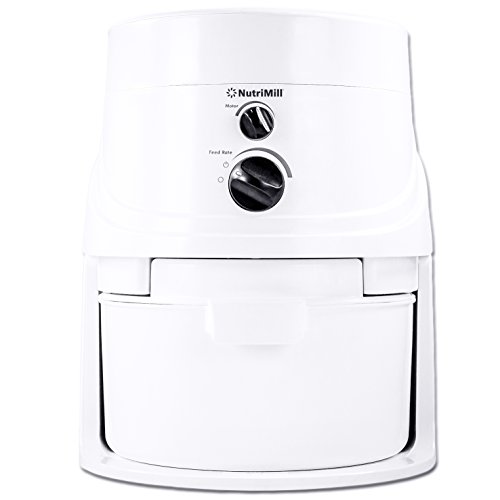
| Saved Amazon status | Documentation only; no exact WonderMill offer or photo | Exact Classic record and matching photo |
Do not transfer the startup and stopping sequence
WonderMill’s manufacturer-linked US manual says never start with grain in the hopper: assemble the dry canister system, turn the motor on, then add grain. It also says to let the hopper finish, run for about five additional seconds and avoid continually adding grain because the 12-cup canister can overfill. An emergency stop uses a specific clear-out and restart process; a mill that only hums should not be repeatedly forced.
Classic’s current product page describes grain-first, power-second loading and auto-restart after a pause. That is a meaningful operating difference, not evidence that one design is universally safer or more reliable. Keep the supplied instructions with the exact appliance and use the troubleshooting guide when normal output changes.
Map every part before comparing the purchase
WonderMill’s working system places the motor unit and canister side by side. The manual requires the separator cup under the lid, dry filter on top and flour tube connected to the mill. Classic lists a motor base, flour bowl, complete flour-bowl lid, hopper extension ring, top lid and separator cup. An incomplete collection system can stop either mill from being a practical bargain.
Measure loading height, side-by-side counter width, outlet or tube clearance, and room to remove the full collection container. If the unit will be stored, measure that configuration separately. Use the accessory guide before comparing a used, open-box or replacement-part package.
The compatibility checker separates documented permissions from unknown combinations.
Check your grain →Use capacity as a session limit, not a yield promise
The WonderMill manual says approximately 8 cups of grain produce 12 cups of flour and explicitly caps the canister at 12 cups. Classic currently lists a 12-cup hopper and 20-cup flour bowl. Those labels make Classic the larger published collection system, but cup volume changes with grain and flour aeration and does not establish actual usable recipe yield.
Write down the flour weight needed for the planned recipes and compare it with one measured batch. Do not keep refilling either hopper simply because the motor is still running. The yield guide and milling notebook preserve the input and output definition.
Keep ingredient permissions tied to the exact model
WonderMill’s US manual explicitly lists dry field corn and unpopped popcorn while excluding nuts, flax, coffee and wet or damp products. Classic’s current grain list names dried sweet corn, oat groats, white and brown rice and other non-oily grains and legumes; a current product Q&A separately says popcorn is permitted. Those sources do not turn every form of “corn” or “oats” into a shared permission.
Use the compatibility checker, corn guide and rice-and-oats guide for the exact form. Wonder Junior manual-mill permissions do not apply to WonderMill Electric.
Compare the exact offer without inventing a winner
Our saved manager records contain one exact NutriMill Classic Amazon listing and matching photo. They contain no exact WonderMill Electric offer or WonderMill photo. The Classic button is therefore labeled as an exact saved match; WonderMill remains documentation-only and should be checked through its manufacturer record rather than a similar-looking marketplace listing.
A missing saved WonderMill record does not prove the model is unavailable elsewhere. Confirm the seller, regional electrical version, all collection parts and current terms for either machine. We have not conducted matched testing and do not rank noise, fineness, speed, cleanup, longevity or bread quality. Older WhisperMill reports are not current WonderMill evidence.
Questions answered
What is the main operating difference between WonderMill and NutriMill Classic?
WonderMill’s US manual requires motor-before-grain startup and a separate side-by-side canister. Classic’s current page permits grain-first startup and lists an integrated 20-cup flour bowl.
Which has the larger published flour container?
Classic lists a 20-cup flour bowl. WonderMill’s US manual caps its flour canister at 12 cups. Treat those as container limits, not measured usable-flour yield.
Is WonderMill the same as WhisperMill?
No. Keep those model identities and their documentation separate. An older WhisperMill test or review does not verify a current WonderMill Electric unit.
Which has an exact saved Amazon offer?
Our saved manager records contain an exact NutriMill Classic offer and matching photo. WonderMill Electric remains documentation-only and does not inherit that offer or image.