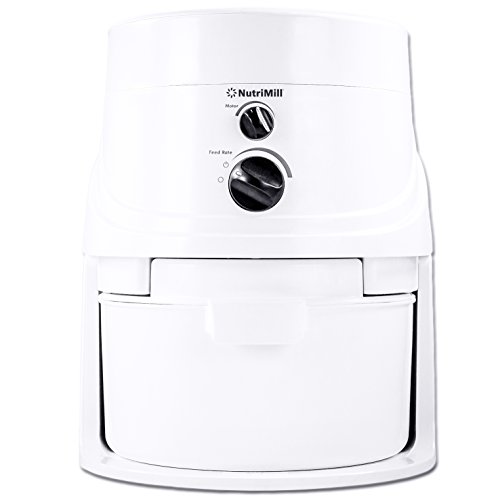
Your next decision
Compare the documented fit, complete setup and limitations for NutriMill Classic, WonderMill Electric.
See the model shortlist ↓| Wheat class on the bag | Documented starting use—not a recipe guarantee |
|---|---|
| Hard red winter | Pan breads, rolls, flat breads and general-purpose flour uses |
| Hard red spring | Strong-dough uses such as bagels, artisan breads and pizza crust |
| Hard white | Whole-wheat or high-extraction flour, pan breads and flat breads with lighter bran color |
| Soft white or soft red winter | Tender products such as cakes, pastries, cookies or crackers |
| Durum | Pasta, couscous and some Mediterranean breads; whole berries are not automatically semolina |
Read the class as a set of traits
Hardness is not bran color: hard red and hard white are both hard wheats. Red and white do not by themselves tell you whether the wheat is hard or soft. Spring and winter describe production classes and can accompany other terms. Keep the complete class or named variety from the package in the milling notebook.
U.S. Wheat Associates documents distinct end uses for the six US classes. Its guidance supports a starting choice, not a promise that a home-milled flour will behave like a commercial flour with a similar name. Protein, crop, extraction, particle size, sifting and recipe method can still change the result.
Start with the bake, then select the class
For a yeast pan bread, flat bread or pizza workflow, a documented hard-wheat class is a more relevant starting point than soft wheat. Hard red winter is a versatile bread class; hard red spring is used for strong dough; hard white is also used for pan and flat breads with lighter-colored bran. Choose among them using the exact recipe and supplier information rather than a universal “best wheat berry.”
For cakes, pastries, cookies and crackers, soft white or soft red winter is the documented class family to investigate. That does not make every soft wheat interchangeable with commercial cake or pastry flour. A whole-grain home-milled flour retains components that a commercial product may not.
The compatibility checker separates documented permissions from unknown combinations.
Check your grain →Keep durum and named heritage grains distinct
Durum is the hardest US wheat class and is documented for pasta, couscous and some Mediterranean breads. Milling whole durum berries at home does not automatically produce commercial semolina: the desired granulation and the mill’s documented grain permission both matter. Do not buy durum solely because the recipe says “pasta” without checking the required flour form.
Spelt, einkorn, emmer, farro and Kamut labels are not synonyms for hard red or hard white wheat. NutriMill Classic’s current resource list permits several of these whole grains, but machine permission does not make them one-for-one recipe substitutes. Preserve the exact named grain in every batch record.
Check the bag and the mill together
Buy grain labeled and sold for human consumption, with a clear identity and storage instructions. Food-grade grain has specifications and safety controls that differ from seed or feed markets; that label still does not prove the grain is suitable for a particular machine. Follow the mill’s requirements for cleaned grain, moisture, hull removal and excluded ingredients.
The compatibility checker points to exact-model documentation. “Wheat” approval can support a general class while a prepared form or unlisted product remains uncertain. When the bag and manual use different terminology, ask the supplier or manufacturer instead of guessing.
Buy a first quantity you can actually use
Estimate rotation from your current routine before comparing bulk prices. At one pound per week, a 5-pound bag represents about five weeks and a 25-pound bag about 25 weeks. That is scheduling arithmetic, not a shelf-life promise. Include storage space, shipping and any grain you may not use when comparing value.
Start with one class tied to a recipe you already plan to bake. Record the result before buying multiple large bags. The flour-cost calculator accepts your delivered price and measured yield; it does not assume bulk grain is cheaper or that every pound becomes usable flour.
Keep identity and raw-flour handling after opening
Label the storage container with the full grain identity, supplier or lot information from the package, and purchase date. Keep packages separate when traceability matters instead of continually topping up an unlabeled bin. The storage guide distinguishes intact grain from flour without inventing a universal shelf life.
Use a recipe appropriate to the flour and cook it fully according to reliable directions. FDA notes that milling raw grain does not kill harmful bacteria. “Freshly milled” does not mean ready to taste raw, and neither the grain label nor the mill establishes suitability for an allergy-specific diet.
Questions answered
What wheat berries should I buy for bread?
Begin with the class named by a reliable recipe. Hard red winter is versatile for pan and flat breads, hard red spring supports strong dough applications, and hard white is used for pan and flat breads with lighter bran color. Then confirm the exact grain is food-grade and allowed by your mill.
Are white wheat berries soft wheat?
Not necessarily. Hard white and soft white are distinct classes. White describes bran color; hard or soft describes a different characteristic, so read the full label.
Can I mill durum wheat berries into semolina?
A mill may grind approved durum berries, but whole-grain output is not automatically the semolina granulation a pasta recipe expects. Verify the mill, setting and required flour form.
Where should I buy grain to mill?
Use a food supplier that identifies the complete grain class or variety and provides package and storage information. Compare delivered cost, quantity and compatibility with your exact mill.