Your next decision
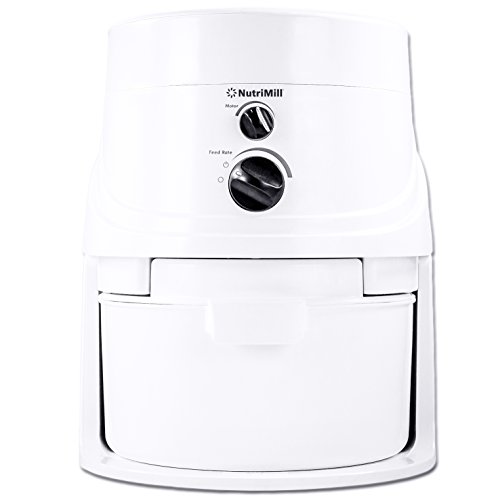
Compare the documented fit, complete setup and limitations for NutriMill Classic, NutriMill Harvest, KitchenAid KGM.
See the model shortlist ↓| Cost bucket | Include in your comparison |
|---|---|
| Working equipment | Mill plus only the mixer, bowl, filter, clamp, heads or other parts required for your chosen setup |
| Delivered grain | Bag price, shipping and any purchase costs you actually pay, divided by the bag weight |
| Usable flour | Your weighed output after sifting, collection loss or flour you choose not to use |
| Milling overhead | Electricity, replacement items, maintenance or a personal labor allowance you choose to count |
| Comparable flour | The delivered cost per pound of the flour you would otherwise buy—not a different flour chosen to improve the result |
Start with the job, not a promised saving
Write down the repeated job the mill would perform: a normal bread batch, a documented grain you cannot readily buy as flour, or a grind range your current equipment does not provide. Then identify the method, collection arrangement and ingredient permission that job requires. A vague promise of healthier flour, better flavor or guaranteed savings is not a usable financial input.
If you already own an appliance whose exact instructions permit dry-grain milling, use the grain-mill versus blender comparison to identify what a dedicated mill would add. The answer may be a workflow benefit rather than a lower cost.
Build the complete equipment number
Count only equipment the chosen system needs, but count all of it. A KitchenAid KGM is powered by a compatible household stand mixer that the manufacturer says is sold separately. A manual mill needs supported mounting and the correct heads or auger. An open-chute stone mill needs a suitable receiving bowl; an enclosed impact mill needs its complete filter and canister system.
Separate required parts from conveniences with the grain-mill accessory guide. If you already own a suitable mixer, bowl or scale, its new purchase cost can be zero. If the actual offer omits a required part, add that part before comparing systems. Do not count the same equipment in both the one-time setup field and the per-pound overhead.
The compatibility checker separates documented permissions from unknown combinations.
Check your grain →Turn delivered grain and measured yield into cost per usable pound
First calculate delivered grain cost: (bag price + shipping) ÷ bag weight. Then divide that result by usable yield as a decimal. For an illustrative 25-pound bag costing $50 plus $20 shipping, delivered grain is $70 ÷ 25 = $2.80 per pound. If a recorded batch produces 95% usable flour by weight, the ingredient cost is $2.80 ÷ 0.95 = $2.95 per usable pound before overhead.
The 95% figure is an example, not a mill-performance claim. Weigh what enters the mill and what you actually use after sifting or collection loss. Save that result in the device-local milling notebook, then enter your own percentage in the flour-cost calculator. Compare with an equivalent flour you would truly purchase, in the same weight unit.
Work a break-even scenario, then stress-test it
Here is illustrative arithmetic only. Suppose required equipment costs $350, delivered grain costs $2.80 per pound, usable yield is 95%, overhead is $0.10 per usable pound, comparable flour is $4.00 per pound, and current use is 8 pounds per month. Home-milled cost is about $2.80 ÷ 0.95 + $0.10 = $3.05 per pound. The difference is about $0.95 per pound, or $7.62 per month. $350 ÷ $7.62 gives a mathematical break-even of about 45.9 months.
Now change one assumption at a time. At 4 pounds per month, the same inputs take about 91.8 months. At 80% usable yield and 8 pounds per month, home-milled cost becomes $3.60 per pound and break-even becomes about 109.4 months. If comparable flour costs $3.00 per pound, these example inputs produce no positive saving and therefore no financial break-even. The calculator handles that outcome explicitly.
Use current habits and name what the math omits
Base monthly use on flour you already buy or recipes you already make. A hoped-for future routine can make equipment appear to repay itself faster than your current behavior supports. Run a normal-use case, a lower-use case and a lower-yield case; the spread is more informative than one favorable result.
The calculator includes taxes, labor, electricity, maintenance, waste and replacement parts only to the extent you put them into bag, equipment or overhead inputs. It does not value storage space, noise, learning time, recipe changes, financing, resale or flour performance. A mill can still be worthwhile for control over ingredients or a preferred routine when there is no financial break-even—just keep that preference separate from a savings claim.
Questions answered
Is milling your own flour cheaper?
Sometimes, but not automatically. Compare delivered grain, measured usable yield, overhead, equivalent purchased flour, complete equipment cost and current monthly use. If the home-milled cost is equal or higher, there is no financial break-even under those inputs.
How do I calculate grain-mill break-even?
Subtract home-milled cost per usable pound from comparable purchased-flour cost, multiply the positive difference by monthly pounds used, then divide additional equipment cost by that monthly saving. If the difference is zero or negative, the scenario has no financial break-even.
Why are grain mills so expensive?
Price alone does not establish value or explain manufacturing cost. Compare the complete working system, documented fit for your task, required parts and what you would otherwise spend; do not omit a mixer, mounting, collection parts or storage to make the total look smaller.
What if the calculator says there is no break-even?
That means the entered home-milling cost meets or exceeds the comparable flour cost. Recheck the inputs for accuracy, but do not force a positive result. A nonfinancial workflow preference can still be a reason to buy if you name it separately.