Your next decision
Compare the documented fit, complete setup and limitations for NutriMill Classic, NutriMill Impact.
See the model shortlist ↓| Decision | Classic | Impact |
|---|---|---|
| Milling method | High-speed impact heads | High-speed impact heads |
| Published controls | Separate feed-rate and motor-speed / texture controls | One feed-rate knob; first notch powers the mill |
| Grain capacity | 12 cups on current product page and comparison chart | 7 cups on product page; 8 cups on comparison chart |
| Flour capacity | 20 cups on current product page and comparison chart | Up to 11 cups on product page; 12 cups on comparison chart |
| Included collection parts | Flour bowl, complete bowl lid and separator cup | Separate canister, canister lid and air filter |
| Published dimensions | 12 × 12 × 13 inches on product page; 13.5 × 11.5 × 14.5 on chart | 16 × 8.25 × 12.875 inches on product page; 15.5 × 8.25 × 13 on chart |
| Saved Amazon status | Exact Classic record and matching photo | Documentation only; no exact Impact offer or photo |
Start with the amount of flour you actually use
Classic’s current 12-cup hopper and 20-cup flour bowl create more stated batch headroom than either published Impact capacity. That can matter when one milling session supplies several recipes, but it is not a measured speed or flour-quality advantage. Impact may be the better layout when a smaller stated batch and nesting canister fit the routine.
Plan in weight rather than treating cups of grain and cups of aerated flour as equivalent. NutriMill notes that Impact flour volume changes with grain, legume and grind setting while weight remains the same. The yield guide shows how to record input, collected output and sifted output without converting a capacity label into a performance claim.
Compare the complete collection system and controls
Classic’s listed package includes the motor base, flour bowl, complete bowl lid, hopper extension ring, top lid and separator cup. Impact lists a motor base, separate canister and lid, hopper and air filter; its resources also require the canister to lock in place and all washed parts to be thoroughly dry before milling. A missing filter, lid or separator is part of the purchase decision, not a minor accessory issue.
Classic publishes separate feed-rate and motor-speed controls. Impact publishes one feed-rate control whose first notch powers the mill and whose higher settings change how quickly grain feeds. Matching 1,200-watt labels do not make those controls or collection parts interchangeable. Use the accessory checklist before valuing an incomplete or used package.
The compatibility checker separates documented permissions from unknown combinations.
Check your grain →Keep both manufacturer conflicts visible
NutriMill’s current Impact product page states 7 cups of grain and up to 11 cups of flour; its current comparison chart states 8 and 12 cups. The two pages also differ on overall dimensions. Classic’s capacity values agree, but its product-page dimensions still differ from the comparison chart. We do not select whichever measurement makes one model look smaller.
For a tight shelf, measure the intended working position and stored position separately, then ask NutriMill or the seller which current drawing applies to the exact SKU. Do not infer that nesting automatically gives Impact the smaller required counter footprint.
Treat offer status as part of the comparison
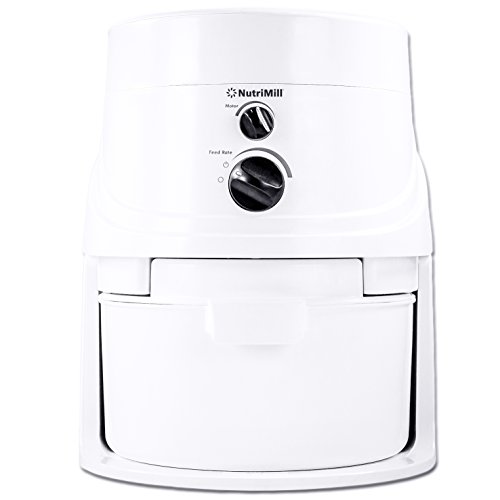
Our saved manager records contain one exact NutriMill Classic Amazon listing and matching photo. They contain no exact NutriMill Impact listing or Impact photo. The Classic button therefore leads to an exact saved model record; Impact remains documentation-only and should not inherit the Classic photo, reviews or offer.
A missing saved offer does not prove Impact is unavailable everywhere. For either mill, compare the exact SKU, regional electrical version, included parts, seller and current terms. We do not state a live price difference or use a temporary sale price as an enduring reason to choose one.
What this comparison does not rank
We have not tested these mills side by side. Manufacturer descriptions of noise, flour temperature, texture and convenience are not independent measurements, so this page does not name a winner for fineness, speed, sound, cleanup, durability or bread quality.
Choose Classic when its larger stated working capacity and separate controls solve a repeated need. Consider Impact when its smaller-batch, nesting-canister arrangement fits better after the conflicting capacity and dimensions are resolved. Then read the Classic guide or Impact guide for exact-model limits.
Questions answered
What is the main difference between NutriMill Classic and Impact?
Classic publishes a 12-cup hopper, 20-cup flour bowl and separate feed-rate and motor-speed controls. Impact uses a separate nesting canister and one feed-rate control, with conflicting 7/11-cup versus 8/12-cup capacity statements.
Is NutriMill Impact smaller than Classic?
Do not assume that from the name or nesting design. Impact has the smaller stated capacity, but current manufacturer pages disagree on the dimensions of both models. Confirm the exact current drawing for a tight space.
Do Classic and Impact use the same parts?
No. Their collection arrangements and listed parts differ. Confirm the exact bowl or canister, lid, separator or filter and hopper pieces for the named model.
Which has an exact saved Amazon offer?
Our saved manager records contain an exact NutriMill Classic offer and matching photo. Impact remains documentation-only; no Classic photo, review or listing is transferred to it.